Faith

Mindful Mondays: Walks Without Destinations

One of the things I like best about living in the South is that winters are shorter and milder, but also less gray than they are in colder areas. Even more than the cold, the eternal grayness of winter is what tends to get me down. It’s been cold enough in South Carolina for us to get some snow flurries last week, but the sun has still been out most days and the sky has been clear and bright. Today it practically feels like spring.

I’m an on-again off-again runner. At different points in my life I’ve trained for and run half marathons and marathons, while in other seasons I’ve done no running whatsoever. I’ve been trying to get back into running for the past month or so with only limited success. It’s always hard to start again once you’ve stopped completely, which I suppose should be incentive not to quit in the first place, but it never seems to work.

In all the self-pressure to get my rear in gear and start running again, I forgot how nice it can be just to walk. On these clear and bright winter days I am content to walk for miles, wandering through neighborhoods I’ve never seen before and down streets I’m still learning the names of. Sometimes I walk while I talk on the phone to my sister or to my mom. Sometimes I walk with my husband and we dream about the houses we pass and an imaginary future where we might live in one of them. But sometimes  I walk with only my own breathing for company, and these are the walks I like best of all.

These are the moments when I’m not so focused on where I’m going or how fast I’m getting there, but simply appreciate where I am. On these walks I can go as slowly as I want to. I can pay attention to the way the roots of the oak trees ripple under the sidewalks, breaking through in some places, and to the chalk drawings left behind by little artists who forgot to sign their names. I walk until I find myself wandering back home, at peace with myself and with the world around me, knowing that even if it only lasts an hour or two, it will be enough.

My eyes already touch the sunny hill.
going far beyond the road I have begun,
So we are grasped by what we cannot grasp;
it has an inner light, even from a distance-

and changes us, even if we do not reach it,
into something else, which, hardly sensing it,
we already are; a gesture waves us on
answering our own wave…
but what we feel is the wind in our faces.

~”A Walk” by Rainer Maria Rilke (translated by Robert Bly)

My To Don’t List

A few weeks ago I was texting with my mom and she mentioned that she’d started making a “To Don’t” list. Since I’m always intrigued by contrariness I asked her to explain. “Instead of making a list of things ‘To Do’ that feels weighty, I’m making a list of things not to do.”

At first I thought a list of don’ts sounded restrictive, like a bunch of rules I’d better not break…or else. The first things that popped into my head were things like, “Don’t be so annoying.” ” Don’t eat so many sweets.” “Don’t just blurt out the first thing that pops into your head because you’re so uncomfortable in social settings.” To me, this sounded like one more list of things to fail at and then feel guilty about the failure.

“I’ve got one,” I texted my mom. “Don’t tell friends with new babies how I really think their kids look.” (Like angry potatoes, for the record. I even found this meme that agrees with me).

49db5be79f9dd94dd32096e04d093140

“Don’t bite random babies cheeks at the grocery store,” she shot back.

“Don’t lick all the cookies and then put them back on the plate.”

“Don’t pick a wedgie with frosting on your fingers.”

We came up with lots of sage advice, but eventually my mom shared some of the things that are actually on her list, things like, “Don’t shy away from challenges,” and “Don’t forget how far you’ve come,” and I started to understand what she meant. Her list wasn’t so much about actions, but about attitudes. I love that because I passionately believe that what’s going on in your head and in your heart matters. So I’m making my own list.

To Don’t:

  • Don’t let other people steal your joy. It’s yours. No one gets to take it from you.
  • Don’t waste time worrying about things that are outside of your control. If it’s outside of your control, then what possible good is your worrying going to do?
  • Don’t beat yourself up for your mistakes. You’re not perfect. Your husband isn’t perfect. Your friends and your family aren’t perfect. Only God is perfect. Don’t expect yourself to be God. Nobody else is expecting you to be either. Actually, they are super happy that you’re not.
  • Don’t call yourself names. If you wouldn’t call someone else fat or ugly, then don’t call yourself that either.
  • Don’t forget that you are loved. Wholly. Unconditionally. Forever. (Deal with it, Shame)
  • Don’t take responsibility for things you aren’t responsible for. You are responsible for yourself and for how you treat the people around you. You aren’t responsible for other people’s responses or actions. Even if they try to convince you that you are, you aren’t.
  • Don’t compare yourself to other people. You are you. Who you are and where you’re at in life is unique to your background, your personality, and your choices. Comparing will only make you feel prideful or dissatisfied. Just do you.
  • Don’t forget to say thank you, for everything, always.
  • And of course, Don’t Stop Believin’. (I know, I know, but it was right there!)

What’s on your To Don’t list?

New Year Blues or One Nasty Case of FOBO

Confession: I love new beginnings. I love cracking open the cover of a new book, running my fingers over the pristine pages of blank notebooks, and lining up a new pack of pens in a neat row. I love the first day of school and the first day of spring and the first day in a new place. I love making neat To Do lists, crossing things off of them, and planning for the future. I like having goals. Sure, when things get tough (or boring) and I get tired (or lazy) I can half-ass it with the best of them, but I always start strong.

Not so this year. We reached New Year’s Day and instead of that bright, crisp my-lungs-are-full-to-bursting feeling of possibility I normally feel in January, I felt nothing. No anticipation, no excitement, and no motivation.

“It’s just that there’s nothing I’m looking forward to this year,” I whined to my husband. “I’m looking at 12 months of being in the exact same place and doing the exact same thing as I am now. What’s exciting about that?” And admittedly, the past few years when we were living in Korea spoiled us with frequent international travel and near-constant opportunities to experience new things. It’s not really surprising that life now seems bland in comparison. What’s surprising is how quickly I’ve become unhappy with our (admittedly) comfortable life.

I’m an introspective person (shocker, I know!) and I spend a lot of time evaluating the whys behind what I do, think, and feel. I think the reasons why we make the choices that we do are important and that our motivations, both positive and negative, matter. After some reflection I think I’ve found the source of my pessimism. I have a nasty case of FOBO.

What’s FOBO? Like its trendy cousins, FOMO (Fear of Missing Out) and YOLO (You Only Live Once), FOBO is a motivation for doing things that is rooted in fear. In this case, Fear Of Being Ordinary.

Sometimes I feel like I’m at war with myself. There’s a part of me that genuinely likes the trappings of domesticity. I LIKE cooking and hosting dinner parties and burning candles and wearing perfume and going to bed at 9:30 PM. I really do. But there’s another part of me that thinks about living that kind of life – settling down somewhere, buying a house, having a couple of kids, waving to my neighbors through the window of my minivan on my way to the church potluck with my famous casserole – and feels utterly stifled by the idea. It is this part of me (as juvenile and prideful as it is) that wants “ordinary” people to be able to look at me and know that I am not like them. The same part of me that wants to wear Marc Jacobs lipstick but still put purple streaks in my hair.

Over the summer my college roommates and I had a reunion. We puttered around the lake in the speed boat and talked about our lives and where we saw them going. The other girls talked about feeling settled – one felt happy to stay near her family, another had recently bought her first house with her husband, one talked about her and her husband’s dream of maybe building a house with a lot of land, and the other talked about visiting her cousin who lived in a beautiful golf-course community and how she could imagine a life like that someday. And I looked around the boat at these women I love, who have such sweet hearts and pure desires, and realized that I don’t want the same things that they do. That even when I feel tired of moving and tired of temporary homes, I can’t imagine settling down in one place. I’m struggling now to think about staying in the same place and doing the same thing for the next year. I can’t imagine living for years and years in the same place, doing the same things. And yet, I can’t deny that there’s a sweetness in that desire too, even if it’s one I don’t share.

I wonder when the word “ordinary” started to burn my tongue like acid. When did living a good, honest, regular life become something to fear or worse, disdain? Was it wrapped up somewhere in the words of the parents and teachers who urged us all to be exceptional? Did I absorb it from the shiny plastic worlds we see on TV? Or is it just a product of my own brokenness and rebellion?

I’m realizing that my attitude towards the ordinary is not OK. I don’t have to resign myself to living a cookie cutter life, but I might just have to make peace with living through a season where my life looks undeniably normal. I might have to lay down my pride and accept that I am living an ordinary life right now and that I don’t have to convince everyone around me that I am a special millennial snowflake. So I pray for the eyes to see the simple value of the ordinary and to sense the sacred motions of the mundane.

There’s Something About Mary: On Women and the Incarnation

Today I have the great honor of sharing a post over at CBE International’s (Christians for Biblical Equality) Arise newsletter which has now been reblogged by Scot McKnight on Jesus Creed (!). This past summer I wrote a satirical piece for Arise about what it means to act like a lady. This time I took a more serious route and wrote about something I think about a lot during the Christmas season – the role of women like Mary in the story of salvation.

“One thing I love about Advent is that you can’t get through it without talking about Mary. Whether you believe that Mary was a saint, an innocent virgin girl, or even if you’re skeptical about the whole virgin birth thing, you can’t deny that without Mary, there would be no Christmas story. Because the story of the incarnation, of God becoming flesh, doesn’t begin in a manger full of sweet, clean hay with a lullaby of softly lowing cattle—it begins in the belly of an unwed teenage girl.

Maybe you believe that Mary was chosen to be the mother of Christ because she was particularly pious and holy. Perhaps you’ve heard sermons like the ones I heard growing up where Mary is held up as an example of virtue, that we might all strive to be holy enough to be called blessed and highly favored as she was.

In reality, we have no evidence that Mary was especially devout. All we know about her is that she was a virgin from the line of David, betrothed to Joseph the carpenter, and that when the angel came to her with astonishing, even absurd news, she simply said, “Let it be to me according to your word.” Mary was an ordinary girl who simply chose to say yes.”

Click here to read the rest of this piece!

New(ish) Ink for My Year of Wholehearted Living

Last January I decided that instead of making resolutions I would just choose one word to focus on for the year. A single word that summed up how I wanted to grow during 2015. I chose the word “wholehearted.” I wrote that:

Wholeheartedness is about sincerity and commitment. For me this means authenticity in my life and my writing. It means commitment to continue my faith-wrestling and to asking sincere questions. Being Wholehearted is also a commitment to courage, compassion, and connection. It is the courage to be vulnerable despite the risk, the compassion to love other people well and to extend grace quickly, both to myself and to others, and the choice to develop genuine connections with others. Wholeheartedness means committing to being fully present, to showing up for every day of my life instead of checking out when things are hard or boring. It means engaging with Today and believing that every day is a gift. And Wholehearted means believing that I am worthy of love and belonging – not because there is anything especially great and deserving about me, but because we are all worthy of love and belonging and because we can’t fully accept love and belonging unless we believe we are worthy of it.

My journey with wholeheartedness isn’t over, but I can honestly say that I think I can see where I’ve grown in these areas. I have taken more risks in trying to connect with people and I have learned to be kinder to myself. I have also failed in some of these areas, and that’s OK too. Choosing one word for the year was never about mastering a particular virtue. It was simply about setting my intentions.

Just before we left Korea in August, I got a new tattoo. It wasn’t something I posted to Instagram or Facebook and I didn’t tell many people about it at the time. It wasn’t meant to be a secret, but it also wasn’t something I wanted to hear a lot of conflicting opinions on or make a big deal about. I wasn’t getting it because tattoos are trendy or because I wanted other people to think I was cooler than I really am. I wanted a symbol of my time in Korea and my journey towards wholeheartedness that would stay with me forever.

I know that tattoos are not everyone’s cup of tea and if you don’t like them, that’s totally fine. There are certainly plenty of people who get tattoos that they later regret. But for me, my tattoos are physical marks of my own story. They remind me of where I’ve been and of the places in my life where God has broken through. I like the permanence of them – the sense that in a world where everything is always changing, these things will always be true and constant.

This tattoo is a compass inside of a mandala. The mandala is a traditional Hindu or Buddhist pattern symbolizing wholeness and unity in the universe. The intricate dot-work shading and the symmetry in the pattern are meant to point to the order in the universe and to our smallness in relation to the greater pattern. I had the compass placed into the middle as a reminder of this time spent living abroad and also that my life has direction. And while these really are meanings I thought about before having this piece done, I also chose it because I think it’s beautiful and I believe that’s a worthwhile reason in itself.

11880909_855398903458_10012120_n

This was when it was freshly done.

84ba26c2-bc8d-4a0d-a9b5-b88469894ca0

And this is what it looks like now that it’s healed.

I chose the placement on my leg partly because it was a big enough area to handle a larger piece like this and partly because it’s relatively easy to cover. It shows when I wear shorts or a swimsuit, but it naturally covered by pants or dress clothes so its no hassle for a more formal setting. I was hesitant about putting it on my thigh which has long been my least favorite part of my body. I wasn’t sure I wanted to call attention to the part of me that I am most self-conscious about. But then I thought, “Why not put something beautiful on this part of you that you don’t think is beautiful?” And the cool thing is, since getting my tattoo it’s become one of my favorite parts of myself. I feel so much more confident and beautiful even if the rest of my legs still jiggle like Jell-O.

11121493_855398918428_2104101572_n

This was also the day I got it. I had my shorts rolled up so they wouldn’t irritate it, but normally my shorts fall right to the middle of the tattoo.

11960005_859460429128_1835978076289442416_n

This is the only picture I can find where you can sort of see where it falls with my regular shorts on. It’s just barely showing here.

2015 is drawing to a close, but my journey towards wholeheartedness will continue into next year and on through the rest of my life.

___________________________________________________

My tattoo is a beautiful, one of a kind piece that was designed for me by an artist in Busan, South Korea. In other words, don’t go get my exact tattoo somewhere on you! Most artists are happy to design something unique for you – they don’t want to just copy other people’s work either.

Feature Image Credit: The Blue Mug

When Two Million People Read About Your Sex Life

A year and a half ago I wrote an article for RELEVANT magazine that was published online and later in print. I was utterly unprepared for the amount of attention it got. It ended up being RELEVANT’s number one article of the year for 2014 receiving over two million hits. This article was re-promoted by RELEVANT today on their Facebook page, so I wanted to post the link to my original reaction piece here for those who may be checking out this blog for the first time.

I have written much more thoroughly and extensively about this topic in a series of guest posts on my friend Brett’s blog and also hosted a series of guest posts from other writers on this topic here on my blog.  If you have questions for me, feel free to reach out here or through my contact page. I love hearing from you!


Things I’m Loving About Being Anglican-ish

Since moving to South Carolina, Jonathan and I have been attending a small Anglican church. We are new to Anglicanism – the rhythms of the liturgy, the symbolism of the vestments, the movements and motions of the Eucharist. While I grew up with a working knowledge of the Catholic Mass, neither of us has ever consistently attended a liturgical church. Over the past few years we have both, for our own reasons, become more and more curious about it.

Jonathan and I come from wildly different church backgrounds – he was raised in a modest-sized, traditional Presbyterian church with a highly educated congregation. I was raised in a large, non-denominational charismatic church that drew people in with exciting music and impressive multimedia presentations. I would have characterized his church as dry and stodgy. He would have characterized mine as hyper-emotional and showy. In the first few years we were first married, we tried to find compromise in what we were looking for in a church – this became more and more complicated as time went on and both of us experienced significant changes in our beliefs. Being in a tradition that is new to both of us feels like a fresh start.

In Korea we visited a very small Anglican church with an English service. While I felt indifferent towards the service itself, I found myself very turned off by the attitude of some of the congregation members. Several of them were former evangelicals who felt they had found something far superior in the Anglican Church. They spoke of their former churches (or even the evangelical church as a whole) with scorn. I’m no champion of evangelical Christianity and I have a whole host of problems with the evangelical subculture, but I’m also deeply sensitive to the arrogance of people who dismiss other denominations’ sincere beliefs simply because they disagree. Just because I have been hurt or disappointed or disenchanted with evangelical Christianity doesn’t mean that God is not at work in those churches or that people who attend those churches aren’t able to have authentic, meaningful faith experiences. In the same way that I have always pushed back against evangelical criticism of Catholicism or of Protestant liturgical traditions, I reject the idea that the only right or good faith tradition is the one I’ve chosen.

Our foray into Anglicanism isn’t about rebelling against the way we were raised, bashing evangelicalism, or trying something new and trendy. It is our way of genuinely seeking to experience God in a new way and to understand our faith differently. I’ve been surprised by the things I’m coming to love about our Anglican church.

Participation is Required: One of the biggest differences in a liturgical service versus a typical evangelical service is that the congregation is required to participate. In an evangelical service you typically sing together for 20 minutes, then sit for 40 minutes and listen to a sermon, sing another song, and leave. In a liturgical service the congregation is required to respond at various intervals, to rise, to sit, to kneel, to speak. I understand that this could become very routine and lose its meaning over time, but for someone new to the tradition, it’s engaging in a way that my previous church experiences were not.

Words Carry Weight: Because the liturgy is scripted, the words have been weighed and measured and written just so. Not one is out of place and not one is without meaning. These are words that have been handed down for generations and they carry with them the weight of centuries of church history.

We are Connected to a Larger Body: Along with this sense of tradition comes a sense of rootedness, and of belonging in the larger body of the church in the world today as well as throughout history. We are not an individual congregation of people doing our own things. We are fundamentally connected to a group of people who are all reading the same passages and speaking the same words on the same day all across the world. There is something powerful about that.

The Eucharist is Central: Unlike most churches I’ve attended where the Eucharist (“Communion”) is a tangential part of the service and is added onto the end once a month or so, the Anglican service revolves around the Eucharist. I’m used to churches where sermons take up the bulk of the service – usually 30 or 40 minutes. In the Anglican Church (and other liturgical churches) the homily is quite short – 10 or 15 minutes – because the real service is building towards the Eucharist. Celebrating the Eucharist starts with corporate prayers of confession and moves into a holy celebration of grace.

Posture Matters: I didn’t grow up kneeling in church. To be honest, kneeling was something we associated with mass, which was (I’m sorry to say) something we frowned upon. But now I find it meaningful to engage my body. For faith to be something I do in the flesh and not just something I say with my mouth or feel in my heart. As my friend Steph writes, “Sometimes to learn a truth so deep in your soul that it changes the way you think, you have to actually do something with your body first.”

The most common question we’ve been asked from friends and relatives is, “Isn’t the liturgy boring? Don’t you feel disengaged when you repeat the same things over and over?” And my answer is simply, “No.”

It’s just as easy for me to disengage while listening to a 3-point sermon or singing a song with a repetitive chorus as it is while saying the Lord’s Prayer. I get out of it what I’m willing to put into it. Perhaps some day I won’t need to hear words like these every week:

“Holy and gracious Father: In your infinite love you made us for yourself, and, when we had fallen into sin and become subject to evil and death, you, in your mercy, sent Jesus Christ, your only and eternal Son, to share our human nature, to live and die as one of us, to reconcile us to you, the God and Father of all.”

But for now, those words are wearing grooves on my heart. Every week they cut a little deeper and sink down a little further into my soul.


Advent Reflections from the Valley of the Shadow of Death

This Sunday marks the first Sunday of Advent, the season of anticipation that leads up to Christmas. Last year, I wrote a post about why Advent isn’t a season of peace and joy, but one of holy longing.

“People are angry about the injustice in the world, disappointed with circumstances in their own lives, or frustrated with their own busyness. All of this disillusionment seems to center on the idea that this is not how the Christmas season should be. I’ve seen a lot of comments along the lines of, ‘This is supposed to be a season of joy, a season of peace, a season of contentment and closeness to our families, a season of celebration.’

I think we may have gotten it wrong.

I don’t think Advent is primarily about peace and joy and all the other warm and fuzzies we think we’re meant to feel. I think Advent is about longing.

It is about longing for a world that is not broken. Longing for justice for the victims of terrorist attacks and police brutality. Longing for restored relationships with our families. Longing for a world where people cannot be bought and sold as commodities. Longing for comfort for the friend who has lost her child. Longing for rest from a world that is moving so fast we feel like if we pause for a moment we’ll get left behind. It is about longing for the hope that we are not abandoned.

Most of us are very uncomfortable with longing. We live in an instant-gratification world, one where it is unacceptable for a need to go unmet or a wish to go unfulfilled, so when we feel emptiness in ourselves, we rush to fill it. Sometimes the desire to satiate longing manifests itself in materialism – the need for the next new thing. Sometimes it shows up in our relationships and we use and abuse other people in our desire to satisfy our longings.

My own attitude towards longing is usually, ‘How can I make this go away?’ But I think we have two choices when it comes to longing – we can lament the discomfort we feel and try to make the feelings go away, or we can embrace those longings and let them change the way we live and love.”

51sESY8dZZL._SX334_BO1,204,203,200_Last week I had the privilege of reading and reviewing Stephanie Ebert’s short collection of Advent reflections, In the Valley of the Shadow, Light Has Dawned: Advent Thoughts in the Wandering. The collection has 5 short readings for each week leading up to Christmas. All I can say is that Steph gets it. As a South African-American she has spent her life in places broken by racism and in desperate need of social justice.  In the introduction to the book she writes:

“Like all Christian celebrations, Advent is acknowledging darkness and remembering light. It’s celebrating and it’s waiting. It’s sweet, but there’s still a trace of bitterness.”

She goes on to say, “If you’re looking for some feel-good Christmas spirit, I apologize: this is not the book for you. But if you’re wandering, or wondering, or grieving, or hurting, or angry, or confused, or fed-up, or used up, maybe there’s something in here for you.”

Each week has a theme with five short readings (except for the last week, which has only two because, as Steph says, “Nobody has time right before Christmas”).

Week One: The Land Where Death Casts His Shadow
“We’re still living in the Valley of the Shadow of Death, but we have a bit of light now.”
Week Two: God With Us: The Incarnation
“God-with-us wasn’t tainted by the common-ness /of skin and flesh and bones./He made skin and flesh and bones holy.”
Week Three: Peace: Wholeness
“But Jesus does everything upside-down. The Kingdom is like a tiny mustard seed, not a machine-gun.”
Week Four: Light Has Shined: Hope in the Face of Darkness
“When we spend our time creating and celebrating the good, we cry out to all the hurt people in the world: This is the way it is supposed to be!”

If you’re looking for a way to acknowledge darkness and still celebrate light, this little book will resonate with you. With discussion questions at the end of each section, it’s a great resource for a small group or a family. But mostly, Steph’s writing is beautiful and her stories and poems and ramblings are worth reflecting on. You can order it here or go over to Steph’s blog for more information about her and her writing.


Full Disclosure: I was provided a free copy of this book in exchange for my honest opinion. I am not under any obligation to review it for you here and have chosen to do so because I genuinely loved it. 


Where Grief and Gratitude Meet

Last week felt like one giant win for Chaos, Fear, and Grief.  It was a week marked by terrible loss. Innocent men and women in Paris and Nigeria and Lebanon and Syria lost their lives to violence. Men and women in my country lost their sense of human decency to fear and self-preservation. A friend of mine in South Africa lost two of his friends last week to cancer. And Jonathan and I and the rest of the Wheaton College community lost two of our beloved English professors in the space of three days. I don’t have words for the collective grief of the world right now. I barely have words for my smaller, personal grief, but I feel that I need to say them anyway.

Grieving people talk about how to make sense of loss or come to terms with pain. I don’t know how to do either of those things. I only know how to say thank you.

849foster

Brett Foster was 42 years old, a brilliant man and gifted poet with an extraordinarily kind and generous spirit. Jonathan and I actually met in Dr. Foster’s Ancient Literature class at 9:00 AM Monday morning our very first day of college. Dr. Foster, listening to you read The Odyssey and The Aeneid brought these epics to life for me in a way I’d never experienced before.  I can still hear your voice in my head when I read them today. Thank you for sharing your passion, your insights, and your love for words with me.

The summer after our freshman year at Wheaton, Jonathan did a summer study abroad program in England led by Dr. Foster along with a few other professors. One afternoon he announced his intention to see a special exhibit and invited anyone who wanted to to join him. Jonathan was the only student who showed up, so he and Jonathan went tot he museum by themselves and spent the afternoon together. Jonathan remembers how incredibly kind, genuine, and down-to-earth he was, even as a professor spending time with a student.

Thank you for seeing beauty in the world, but more than that, thank you for bringing beauty to the world through your words, through your authenticity, and through your generous spirit.
C9E103BB-8833-42FA-A941-9BE808737E09-990x417

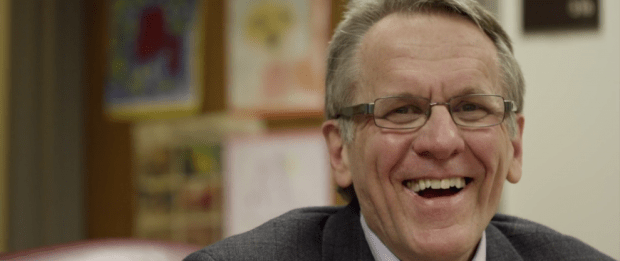
Roger Lundin was dear to me in ways I don’t know that I can explain. Of all of my professors at Wheaton, he was perhaps the one who left the biggest impact. His death was sudden, unexpected and also much too soon. Dr. Lundin was big in every sense of the word – a tall man with long lanky limbs ending in large hands and feet, a huge, booming voice, a staggering intellect, and an enormous, tender heart.

He had a memory like no one else I’ve ever known. I once went to his office to discuss a paper I was having trouble with. “This is what I want to talk about, but I’m just not sure how to tie it in with the larger historical context.” He leaned back in his chair and thought for no more than 15 seconds before saying, “There’s a book I think you can find in the school library,” he named an obscure title, “and around page 140 there is a paragraph near the bottom of the page that speaks to exactly what you’re saying.” I left his office and went to the library where I found the book and the passage exactly where he said I would.

Last fall when Jonathan was applying for graduate school, he asked Dr. Lundin to write him a recommendation. Being nearly five years out of college, he was apologetic and tried to remind him of who he was. Dr. Lundin wrote back, “Of course I remember you. I think of you and Lily often and wonder how you’re doing in South Korea.”  He said he would be delighted to write the recommendations.

Most significantly for me, though, he had a dear and tender spirit. Through years of classes with him, I was repeatedly moved by the way he spoke of his wife – someone he regarded as the best and most vital part of himself and whose wisdom and input he not only deeply respected, but found essential. During my senior year at Wheaton when Jonathan and I were engaged I started seeing a therapist. I was trying to come to terms with how someone as deeply afraid and distrustful of men as I was could possibly enter a marriage. I remember telling my therapist, “There are only four men in the world I’ve never felt threatened by or afraid of in some way: my dad (though I was deeply afraid of his disapproval), Jonathan, my friend Leigh’s dad who I grew up with, and Dr. Roger Lundin.” (I’m sure there were people I wasn’t thinking of, but that’s how I felt at the time. You get the idea, I had issues).

Dr. Lundin, I think I remember ever story you ever told. Thank you for making me love Emily Dickinson and Dostoyevsky, for introducing me to Milosz, and teaching me that literature and faith were inseparable. But mostly, thank you for teaching me not to apologize for who I am, and for making me believe that there were men in the world who could be trusted and that marriages really could be beautiful, equal partnerships.

****

I confess that I don’t want to die and I think it’s brutally unfair that these men died last week. I am one of hundreds, of thousands, of students whose lives were shaped by these men and in a small way, it comforts me to know that I am just one of many who care deeply that these men lived and mourn deeply that they’re gone.

There is nothing I can say to make this sting less. All I’m left with is, “Thank you.” Thank you for sharing yourselves with me, and with so many others. Thank you for showing me how to live a life that matters. Thank you for being exquisite examples of lives well-lived.

The following is a poem that Dr. Foster wrote as he neared the end of his life. I want to finish with just this, Dr. Foster, you did give the sickness and the shivering meaning. And you and Dr. Lundin both showed us all how to go out singing. I’m deeply saddened that you’re gone, but I am profoundly grateful for the lives you lived.

Isaiah 43

I am making all things new! Or am trying to,
being so surprised to be one of those guys
who may be dying early. This is yet one more
earthen declaration, uttered through a better
prophet’s more durable mouth, with heart
astir. It’s not oath-taking that I’m concerned
with here, for what that’s worth— instead just a cry
from the very blood, a good, sound imprecation
to give the sickness and the shivering meaning.
Former things have not been forgotten,
but they have forgotten me. The dear, the sweet,
the blessed past, writes Bassani. Tongue is the pen.
Donning some blanket of decorousness
is not the prophet’s profession, not ever.
Not that I’ve tasted the prophet’s honey or fire:
I’m just a shocked, confounded fellow
who’s standing here, pumping the bellows
of his mellifluous sorrow. Yet sorrow’s the thing
for all prophets. Make a way in the wilderness,
streaming your home-studio-made recordings
from a personal wasteland. These are my thoughts.
I can’t manage the serious beard. My sackcloth
is the flannel shirt I’m wearing. But the short-circuited
months have whitened my hair, and it’s not
for nothing that Jeffrey calls me, with affectionate
mockery, the silver fox. It’s a prerequisite, finally—
being a marginal prophet, but a severe attention
to envisioned tomorrows must be present, too,
must be perceived as possible, audible, or followable.
There’s a hypothetically bright future for everything,
each wounded creature that is bitten, or bites.
And speaking of things overheard, you heard right:
if I have to go out, I am going to go out singing.

Fifty Two Weeks of Adventure # 40: The 1,000 Year Storm

Over the past few days South Carolina has experienced what is being described as a “1,000 year storm.” Parts South Carolina experienced several feet of rainfall over a two-day period resulting in massive flooding as rivers overflowed their banks and dams burst.

My own city, Columbia, has been hard-hit by the storm. While we are fortunate to be living in a second floor condo in a complex set up on a hill, roads have collapsed and homes have been lost within a quarter mile of us. I grew up in southern Louisiana and have lived through dozens of hurricanes. Other than Katrina, I’ve never seen flooding like this. Buildings have collapsed and sinkholes have opened up and swallowed roads and there are houses with water up to the roofs.

This is the street right outside of my complex. It's a miracle we still have power. Ours must run from the other side of the street.

This is the street right outside of my complex. It’s a miracle we still have power. Ours must run from a different line.

The vet’s office where I took my cats for a check-up on Friday afternoon was covered by three feet of water by Sunday morning. There’s been an eerie, post-apocalyptic feel to the past few days. Everything is quiet except for the frequent sound of sirens and helicopters and the roads are abandoned.

Today the sun is out for the first time in what feels like weeks, but roads are still closed in nearly every direction, so there is nowhere really to go. We are very thankful to have power and running water (though everything has to be boiled) as there are many without. Thirteen people have lost their lives and countless others have lost their homes, their cars, and their businesses.

This intersection is less than a mile away from my home. I drive through it nearly every day.

This intersection is less than a mile away from my home. I drive through it nearly every day.

As a child, the story of Noah and his ark was an enchanting mixture of animals and big puddles and a great wooden boat. Now I can’t help but think of how frighteningly powerful water is. In our culture where we think of the earth as a resource we can bend to our will, we’ve forgotten how strong nature can be and how small and fragile we are in comparison.

69oXkQf

Pray for the many who have lost everything so suddenly. Pray for necessary resources to repair and rebuild, and for the restoration of these communities. I still feel like an outsider here, but I can’t help being grieved for all of these losses.

This week’s adventure was a not-so-happy one, but I hope your week has been better.

If you have an adventure to share, add your link to the link-up by clicking the button below. You can also click this button to read other bloggers’ adventures. You can participate in all of the adventures or you can just do a few. If you missed last week’s adventure where I ugly-cried at my best friend’s wedding, you can find it here. And if you are new to my Fifty-Two Weeks of Adventure project you can find out more about it here.